Dumoulin Mansion
The Vampire's Pet: Romantasy at its darkest (Blood and Kisses Chronicles : A Dark, Gothic Romance Series)Dumoulin Mansion is the ancestral home of Aleksander Dumoulin and the central domestic space through which the story traces his changing relationship with Esmeralda. At first, it is an imposing inheritance shaped by aristocratic family history and vampire privilege: a beautiful, secluded residence whose order depends on exclusion. Once Esmeralda is brought inside, however, the mansion becomes more than a possession. It is first a controlled enclosure for a human pet, then a shared household in which Aleksander discovers attachment, and finally the wrecked evidence of a conflict that reaches across the boundaries of vampire society.
Architecture and Inherited Identity
Dumoulin Mansion stands at the end of a broad, tree-lined plot enclosed by a wrought-iron fence. Balconies overlook the second-floor bedrooms, while stained-glass windows—an expensive feature insisted upon by Aleksander’s great-grandfather—catch the eye beneath a Victorian roof that gives the house an air of grandeur. A large garden of flowers and shrubs extends behind it, providing the setting for Aleksander’s solitary walks. The mansion’s scale and ornament preserve the family’s elevated status even when the household itself has contracted.
That grandeur is inseparable from loss. After Aleksander’s parents die, only a few servants remain with him, leaving the house unnecessarily large for one occupant. His mother had urged him to find a vampiress and establish a family, but his relationships with many vampiresses had produced no partner who felt right. The empty rooms therefore embody both lineage and stasis: the residence has survived across generations, yet it offers Aleksander no meaningful future until Esmeralda’s arrival changes the emotional use of the space.
The mansion also reflects the political order outside its gates. In the city, the Queen’s reinstated Old Vampire Laws have been followed by the opening of Human Breeding Farms, the tearing apart of hybrid families, and the violent suppression of protest. Aleksander recognizes corruption in the Queen’s regime but does not allow that knowledge to affect his work for the castle, and his own attraction to the revived predatory hierarchy makes the mansion a private extension of the society around it. Its fence separates an aristocratic vampire interior from a transformed city in which Humans have been pushed back into subordination.
The Mansion as Enclosure
Aleksander returns to Dumoulin Mansion after deciding that his growing craving for fresh blood should be answered by acquiring a pet. The decision follows his encounter with a pet at the castle and develops into an obsession that blood wine, once associated with his family’s idea of civilized restraint, can no longer satisfy. The mansion thus becomes the destination of a desire that Aleksander initially tries to dismiss but ultimately institutionalizes within his own home.
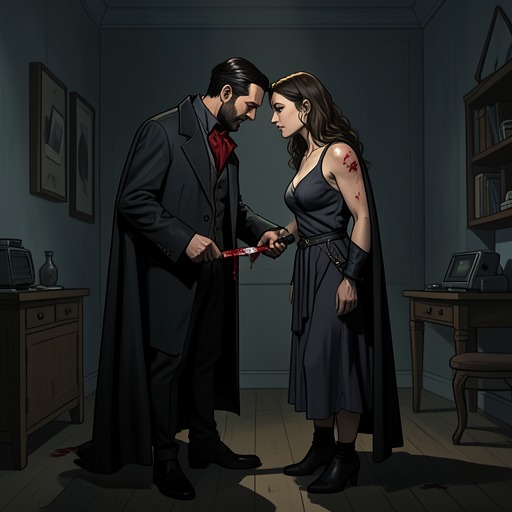
After purchasing Esmeralda, Aleksander presents her to the servants and establishes precise rules for her treatment. She must not be beaten or bitten, her Black Gemstone Collar must remain on at all times, and she is forbidden to go outside. He permits her to choose a book from the library, but first orders Judith to take her to the baths and provide proper clothing. These instructions combine protection with ownership: violence by the household is prohibited, yet Esmeralda’s movement remains controlled, and the collar makes her status as a vampire pet visibly permanent.
The household’s formal discipline does not conceal Aleksander’s uncertainty. Living alone for hundreds of years, he has no experience caring for another person, especially a Human. He understands that Esmeralda needs food and sleep but is unsure what else would allow her to be well or whether she can adapt to captivity. Within the mansion, that practical confusion becomes the beginning of an unfamiliar emotional response. Caring for Esmeralda and trying to secure her happiness awakens a sweetness Aleksander has never known, making the supposedly one-sided arrangement unstable from its first days.
A Domestic Ritual of Intimacy
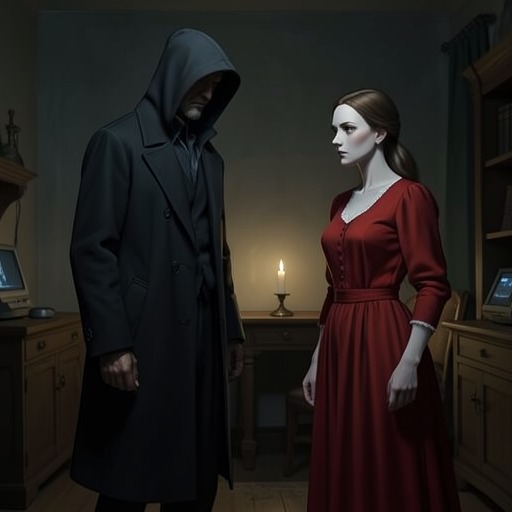
At dinner, the mansion’s long wooden table stages the first transformation of ownership into fascination. Aleksander sits at one end, lazily swirling Blood Wine in a glass and watching its crimson liquid, then holds his breath when Esmeralda enters in a gown of black lace and white satin. Her hair is combed back with a brooch that complements the stone set in her collar, and the lilac fragrance from her cleaned body reaches him across the room. The scene places the controlled object of his appetite within an elaborate domestic ritual, but his response is not merely consumption: he is visibly nervous, attentive, and captivated by her presentation.
Conversation also reveals how far outside ordinary vampire society Esmeralda comes. She explains that she grew up in a pack of Werewolf Witches far to the northwest, despite being born without either a wolf or magic. Her background accounts for her lack of knowledge about Vampires, while the broader hostility between Werewolves and Vampires explains why her pack would remain distant from the city. The mansion is therefore not an isolated refuge but a contested cultural border, holding a member of a reclusive werewolf community inside a vampire household.
As days pass, Esmeralda stops trying to escape and becomes joyful and determined. She grows content with life at the manor and routinely asks Aleksander to drink her blood. Her willingness reverses the emotional direction of the house: the captive is no longer represented only by resistance, while the owner becomes increasingly dependent. The more Esmeralda enjoys herself, the more addictive her blood becomes to Aleksander, who is intoxicated by it daily and surrenders himself to her as she sings his name.
The deepest change occurs in the bedroom. When Esmeralda asks to sleep in Aleksander’s bed, he discovers that he wants her to remain with him. He has slept alone for centuries, yet her bodily warmth and scent make shared space feel natural. He moves her belongings into his room, admitting her into the most personal part of the mansion, and begins going to bed when she does despite needing less sleep than a Human. Waiting for her to fall asleep and listening to her breathing turns the house’s former solitude into a ritual of watchfulness and attachment.
Destruction and the Reach of the Pack
The mansion’s apparent security ends while Aleksander is away buying Esmeralda a bouquet of red and white flowers ranging from rose to crimson. As he approaches, a knot forms in his stomach: the windows are shattered, stained glass covers the floor, and the front door hangs open and off its hinges, marked by claw scratches. He drops the bouquet upon seeing the interior overturned. Torn armchairs, peeling fabric, battle scars on the walls, and dust still hanging in the air convert the residence from a symbol of inherited stability into a record of sudden violence.
Crying from the kitchen leads Aleksander to the surviving servants. Judith explains through sobs that the Werewolves came, destroyed everything, and that the household had been trying to protect Esmeralda. One servant has died, and the attack exposes the limits of Aleksander’s rules and preparations: the collar, the mansion, and the servants could not secure Esmeralda against a determined pack. The assault is especially shocking because it occurs in broad daylight and in the middle of a vampire city, demonstrating that the residence’s boundary cannot contain the political and familial claims surrounding its newest occupant.
The destruction also forces a reinterpretation of Esmeralda’s presence. Aleksander had assumed that enough time had passed since he bought her for her pack never to come for her, but the scale of the attack suggests that she holds an importance beyond that of an ordinary member. The ruined mansion becomes the material sign of a secret he had not understood: Esmeralda is the daughter of the pack’s Alpha and Luna and the next leader of the pack. Its collapse therefore marks the moment when the household’s private arrangement collides with the authority of her original family.
Competing Claims Over the Household
The attack makes Dumoulin Mansion the point at which several systems of authority confront one another. Aleksander’s household rules define Esmeralda as a protected but confined Human pet; the Werewolf Witches’ family structure defines her as the daughter of the Alpha and Luna and the future leader of their pack. Alyson’s authority is particularly important because she challenges the Alpha’s objections to her decision, asking, “Since when do you question your Luna’s choices?” Her intervention shows that the mansion’s supposed private domestic order has been judged from outside by a different communal law, one in which Esmeralda’s mother can determine where her daughter belongs.
The conflict is not resolved simply by restoring the house or punishing its attackers. Alyson tells Aleksander that the pack believed Esmeralda was being held prisoner and badly treated, an interpretation supported by the mansion’s actual conditions when Esmeralda first arrived: she could not leave, had to wear the Black Gemstone Collar, and lived under explicit restrictions. Aleksander remembers that Esmeralda had tried to escape on her first night and feels guilt because, at that stage, she truly was a prisoner. The ruined mansion thus preserves a moral record as well as physical damage; it exposes the difference between Aleksander’s later understanding of their bond and the coercive circumstances that began it.
From Captivity to Chosen Belonging
The mansion’s meaning changes because Esmeralda’s own position changes within it. Her decision to stop running, her repeated requests that Aleksander drink her blood, and her invitation to share his bed transform the residence from a place imposed upon her into a home she actively inhabits. Aleksander moves her belongings into his room and begins organizing his days around her sleep, breathing, scent, and presence. These details do not erase the original imbalance between owner and pet, but they make the household emotionally reciprocal in a way its rules were never designed to permit.
That reciprocity becomes decisive when Alyson accepts the claim that Aleksander is Esmeralda’s fated mate, the partner given by the moon goddess. Alyson tells him that, if the claim is true, he is the one Esmeralda should be with, and Esmeralda turns to her mother in gratitude. The statement grants a supernatural and familial legitimacy that the mansion’s collar and ownership language cannot provide. What began as Aleksander’s purchase of a Human is therefore recast through a higher bond and through Esmeralda’s expressed choice to remain with him.
A House Rewritten by Violence
Dumoulin Mansion undergoes a sharp visual and emotional reversal. Its tree-lined approach, wrought-iron fence, stained glass, Victorian roof, and cultivated garden establish a protected aristocratic enclosure; its long dining table and private bedroom later host rituals of attraction and shared life. After the Werewolves’ assault, the same structure is defined by broken windows, scattered stained glass, a torn-open entrance, destroyed furniture, scarred walls, and dust. Beauty and ruin are not separate settings but successive states of one domestic space.
The destruction also reveals that the mansion’s isolation was always conditional. Its fence could mark social distinction, and its rooms could regulate Esmeralda’s movements, but neither could withstand the claims of her pack. The household’s servants tried to defend her and one died, while Judith and the others were left grieving amid the wreckage. The mansion consequently becomes a threshold rather than a sealed refuge: it is where vampire privilege, Human subordination, Werewolf kinship, and the fated-mate bond meet, each demanding a different answer to the question of whom Esmeralda belongs with.
Narrative Significance
As a location, Dumoulin Mansion materializes Aleksander’s inner trajectory more clearly than any abstract declaration could. Its inherited grandeur reflects his attachment to lineage and the vampire hierarchy, while its excessive size records centuries of isolation after his parents’ deaths. The arrival of Esmeralda fills that emptiness with care, appetite, domestic ritual, and physical intimacy; the later attack tears open the illusion that private desire can remain separate from public law and family obligation.
The mansion therefore functions simultaneously as ancestral monument, prison, refuge, and contested home. Its library, baths, dining room, and bedroom chart the gradual movement from imposed custody toward shared routine, while the shattered front entrance reverses that movement with a single eruption of outside force. By the time Alyson recognizes the fated-mate claim, the house has already shown why that recognition matters: Dumoulin Mansion can shelter Esmeralda only when shelter is no longer confused with possession, and its ruins make visible the cost of learning that distinction.